Tampilkan postingan dengan label Anatomy. Tampilkan semua postingan

Atlas of Surgical Anatomy

Alain C. Masquelet

Taylor & Francis, 2005
232 pages

The author of a number of acclaimed, best-selling surgical atlases has collaborated again with an award-winning artist to produce another invaluable surgical resource. This highly regarded team provide a master-class in the demonstration of surgically relevant anatomy. Masquelet has attained world-renown in particular for his innovative flaps for reconstructive plastic surgery of the limbs, in this book he displays his unrivalled knowledge of surgery of the trunk, head, and neck. Every point of entry in required surgical procedures is described, and every procedure is illustrated with a sequence of drawings, displayed as the surgeon would see them, together with anatomical cross-sections.


CLICK HERE TO DOWNLOAD

Atlas of Morphology, Functional Anatomy of Brain


Atlas of Morphology, Functional Anatomy of Brain

T. Scarabino, U. Salvolini

Springer, 2010
127 pages

This dual atlas aims at illustrating the anatomy of the brain and its appearance on MR images using a simple and effective mode of presentation. Following an introductory chapter, "Comprehensive anatomy of the human brain", the book is divided into a morphological and a functional imaging section. The morphological atlas presents 3D surface images followed by high-definition MR sections acquired in the axial, coronal, and sagittal planes. The MR images are paired with the corresponding anatomical images to enable their clinical correlation. The functional atlas includes illustrative MR images showing cortical activation in various functional areas (including the auditory, motor, visual, and language areas).

CLICK HERE TO DOWNLOAD

Anatomical Terms and their Derivation


Anatomical Terms and their Derivation
F. Peter Lisowski, Charles E. Oxnard

World Scientific, 2007
126 pages

Anatomical terms are the vocabulary of medicine. Anatomy began as a descriptive science in the days when Latin was the universal scientific language. Early anatomists described the structures they saw in that language, comparing them to common and familiar objects, or borrowing terms from the Greek and Arabic masters before them. In anatomic terminology, common Latin or Greek words are used as such for any part of the body for which the ancients had a name. For many other structures, scientific names have been invented either by using certain classical words which appear to be descriptive of the part concerned, or commonly, by combining Greek or Latin roots to form a new compound term. Memorization of such terms without understanding their meaning can lead to mental indigestion. As an aid to comprehension, this book also presents the roots from which many of these descriptive terms and compounds are derived. For practical convenience, the book is organized into abbreviations, prefixes and suffixes, general terms common to all body regions, short lists for each major body part, and an alphabetical list covering the entire body. This pocket-sized handbook is essential for anyone wishing to learn and understand medical terms.

DOWNLOAD HERE

5+ Anatomy Mnemonics


Lumbricals action
Lumbrical action is to hold a pea, that is to flex the metacarpophalangeal joint and extend the interphalangeal joints. When look at hand in this position, can see this makes an "L" shape, since L is for Lumbrical.

Carpal bones: trapezium vs. trapezoid location
· Since there's two T's in carpal bone mnemonic sentences, need to know which T is where:
TrapeziUM is by the thUMB, TrapeziOID is inSIDE.
· Alternatively, TrapeziUM is by the thUMB, TrapezOID is by its SIDE.

Medial malleolus: order of tendons, artery, nerve behind it
"Tom, Dick, And Nervous Harry":
· From anterior to posterior:
Tibialis
Digitorum
Artery
Nerve
Hallicus
· Full names for these are: Tibialis Posterior, Flexor Digitorum Longus, Posterior Tibial Artery, Posterior Tibial Nerve, Flexor Hallicus Longus.
· Alternatively: "Tom, Dick ANd Harry".
· Alternatively: "Tom, Dick And Not Harry".

Supine vs. prone body position
Know SUPination is your hand while carrying a bowl of SOUP. Your face follows where your palm is facing [i.e. up]. Put a handpuppet on your hand while hand is in supination and the puppet will be the supine position.

Elbow: which side has common flexor origin
FM (as in FM Radio):

Flexor Medial, so Common Flexor Origin is on the medial side.

Tibia vs. fibula: which is lateral
The FibuLA is LAteral.

Popliteal fossa: muscles arrangement
The two Semi's go together, Semimembranosus and Semitendonosus.
The Membranosus is Medial and since the two semis go together, Semitendonosus is also medial.
Therefore, Biceps Femoris has to be lateral.
Of the semi's, to remember which one is superficial: the Tendonosus is on Top.


15+ Best websites for learning Anatomy

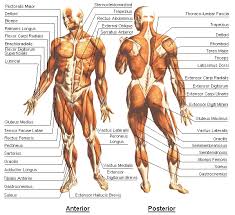
Anatomy (from the Greek ana: separate, apart from, and temnein, to cut up, cut open.) is a branch of biology and medicine that is the consideration of the structure of living things. It is a general term that includes human anatomy, animal anatomy (zootomy) and plant anatomy (phytotomy). In some of its facets anatomy is closely related to embryology, comparative anatomy and comparative embryology, through common roots in evolution.

Anatomy is subdivided into gross anatomy (or macroscopic anatomy) and microscopic anatomy.Gross anatomy (also called topographical anatomy, regional anatomy, or anthropotomy) is the study of anatomical structures that can be seen by unaided vision with the naked eye.Microscopic anatomy is the study of minute anatomical structures assisted with microscopes, which includes histology (the study of the organization of tissues),and cytology (the study of cells).

The history of anatomy has been characterized, over time, by a continually developing understanding of the functions of organs and structures in the body. Methods have also improved dramatically, advancing from examination of animals through dissection of cadavers (dead human bodies) to technologically complex techniques developed in the 20th century including X-ray, ultrasound, and MRI imaging.

Anatomy should not be confused with anatomical pathology (also called morbid anatomy or histopathology), which is the study of the gross and microscopic appearances of diseased organs.

Here are some of the best websites on the web to learn Anatomy from. This list contains 16 websites with good Anatomy content.

A GOOD SOFTWARE EXPLAINING BASIC CONCEPTS IN ANATOMY.


FOR SERIES 60 Symbian OS

FORMAT = SIS

VERSION = 1.1

SIZE = 2.35 MB


This is a simple software showing basic anatomy ,ya simple anatomy for an orientation only, dont expect detailed anatomy lectures or animations....

  • Download file from the link

  • Extract content using WINRAR

  • Rename the file with a .sis extension.

  • Then install in your symbian phone

  • Open the program ,press option->start


Now you can read your files. The program uses the phone's default web browser for this purpose. But no internet connection is required. It's like reading a saved webpage.

PASSWORD TO THIS FILE - www.medicalworld.co.nr

Click here to Download

Provided by: Mihd.net

A Range of Medical books from a Rapidshare user.


I stumbled upon this user in rapidshare who gives cool medical ebooks for download. I have categorised into various branches exactly as he had done. If the links doesn't work, then it means the repective owner has deleted the files from his/her account.

Share and enjoy!

14 Medical Textbooks download page


This is the link to a 4shared.com page which jas download links to 14 Medical ebooks. The category is that of Basic Medicine and the textbooks are common references for a medical student.
  1. 12-Infectious diseases in children,dermatology, spot the rash, december 2008.pdf
  2. Anatomical Terms.pdf
  3. Bones and Muscles.pdf
  4. Clinical acid base physiology.chm
  5. Clinical Physiology,An Examination Primer2005.pdf
  6. Ganong Physiology-23e.rar (featured)
  7. Ganong Physiology 21e.pdb (featured)
  8. Guyton Textbook of Medical Physiology 11th ed.pdf (featured)
  9. Introduction to the Anatomy and Physiology of Children.pdf
  10. Laboratory exercises in microbiology.pdf
  11. Medical Embryology.pdf
  12. Neuroanatomy_2ed.djvu
  13. Pulmonary Anatomy,Physiology,Evaluation2005.pdf
  14. Vander renal physiology.chm

Feature on William Francis Ganong, Jr- the author of one of the best medical textbook, Ganong Physiology:

William Francis Ganong, Jr. (July 6, 1924– December 23, 2007) was a Harvard-educated American physiologist, and was one of the first scientists to trace how the brain controls important internal functions of the body. He was born in Northampton, Massachusetts, the son of renowned botanist and Smith College professor, William Francis Ganong, Sr..

He was a graduate of Harvard Medical School and served with the United States Army during World War II and the Korean War in which he was part of a medical team that established a MASH unit, the Hemorrhagic Fever Center.

A neuroendocrinologist, he was the Lange Professor of Physiology Emeritus at the University of California, San Francisco and served as the 50th president of The American Physiological Society, from 1977 to 1978. In the course of his research, he discovered that blood pressure and fluid balance — the salt and water levels in the body — are regulated by hormones from the adrenal gland and the kidney, a key finding for developing ways to treat hypertension. He was also one of the discoverers of Lown-Ganong-Levine syndrome, an electrical abnormality that affects heart rhythm.

He was the author of the book Review of Medical Physiology, first published in 1963 and currently in its 23rd edition and has been translated into 18 languages.

William Francis Ganong, Jr. died in Albany, California.

A feature on Arthur Clifton Guyton:

Arthur Clifton Guyton (September 8, 1919 – April 3, 2003) was an American physiologist. He was born in Oxford, Mississippi, to Dr. Billy S. Guyton, a highly respected eye, ear, nose, and throat specialist, who later became Dean of the University of Mississippi Medical School, and Kate Smallwood Guyton, a mathematics and physics teacher who had been a missionary in China before marriage.

Guyton's Textbook of Medical Physiology became a household name in medical schools. From the ninth edition onwards, John E. Hall co-authored the textbook. However, all prior editions were written entirely by Guyton, with the eighth edition published in 1991. Subsequent editions, including the latest, preserve his legacy within the title, Guyton and Hall Textbook of Medical Physiology.


Click here to Download

A list of 15+ Atlas type books from 4shared.com


I have found out a bank of 17 Atlas type ebooks for Medical studies. I hope you will enjoy the collection. The free medical ebooks are stashed in a 4shared account. As long as the account is valid, the contents will be available.

Click here to visit the FREE medical ebooks download page.

  1. An Atlas of Surgical Anatomy.pdf
  2. Atlas Epilepsy Care in the World.pdf  
  3. Atlas of Clinical Diagnosis 2nd_Ed.pdf 
  4. Atlas of Dysmorphology.pdf 
  5. Atlas of Genetic Diagnosis and Counseling.pdf
  6.  Atlas of Hand Bone Age.pdf 
  7. Atlas of Pediatric Neuropathology.pdf 
  8. Atlas of Procedures in Neonatology.CHM
  9. Atlas of The Newborn.pdf 
  10. Atlas pediatric-perinatal pathology.pdf
  11. Clinical and Radiology Atlas.exe 
  12. Color Atlas of Human Poisoning and Envenoming.pdf
  13. Color Atlas of Physiology.pdf 
  14. Illustrated Manual of Pediatric Dermatology.pdf 
  15. Netter atlas of physiology.pdf 
  16. Pocket Atlas of Oral Diseases.pdf 
  17. The Bedside Dysmorphologist2008.pdf


Click here to visit the FREE medical ebooks download page.

A Set of 16 Anatomy and Physiology eBooks for Free Download


CONTENTS of this File Pack:
There are 16 ebooks related to anatomy and physiology in this file pack. Download this exquisite collection of ebooks from esnips.com now. It's totally free!

ANATOMY AND PHYSIOLOGY BOOKS FREE DOWNLOAD:
Click here to DOWNLOAD


The set consists of the following 16 books on Anatomy and Physiology:
  1. Ganong - Review of Medical Physiology 21st Edition
  2. Color Atlas of Biochemistry 2005
  3. Color Atlas of Physiology
  4. Color Atlas of Histology & Cytology
  5. Basic histology text and atlas
  6. Clinincal anatomy
  7. Anatomy At a Glance
  8. Schaum's Outline of Human Anatomy and Physiology
  9. Pinsky Applied Physiology in Intensive Care Medicine
  10. Vander Human Physiology The Mechanism of Body Function 8 edition
  11. Netter atlas of physiology
  12. Medical physiology 2nd edition
  13. Langman's medical embryology
  14. Interactive atlas of human anatomy version 30
  15. Human physiology the basis of medicine 3rd edition
  16. Guyton's Textbook of Medical Physiology.

Click here to DOWNLOAD
 
Copyright © 2011 Medicine e-books | High CTR Blogspot Themes designed by Ali Munandar | Powered by Blogger.Com.